
– By Shubhodeb Bhattacharya
India doesn’t have a shortage of talent. It has a shortage of doors that open when talent knocks!
Here’s a number worth sitting with: India’s unemployment rate holds near 3.1%, but among graduates it’s 11.2%, more than three times the national average. One in four young Indians today is neither working, studying, nor training for a job, according to the latest Periodic Labour Force Survey. Read that again.
The more educated a young Indian is, the harder it can be to find work. That’s not a footnote, but the core contradiction defining the country’s employment story.And that’s exactly why tackling unemployment in developing countries requires more than economic growth on paper. It requires rethinking how we train young people, where that training is provided and who it encompasses.
This blog takes a deep dive to highlight what’s driving unemployment in India and what it costs when left unaddressed. From there, the focus shifts to how skilling organisations like Anudip Foundation are working to change this story. Anudip reaches youth from the margins, including women trafficking survivors and persons with disabilities, helping turn these numbers around, one learner at a time.
Causes of unemployment in India
The stats above don’t happen by accident. They’re the visible symptom of several structural gaps working together.
Let’s take a look at these:
A widening skills mismatch
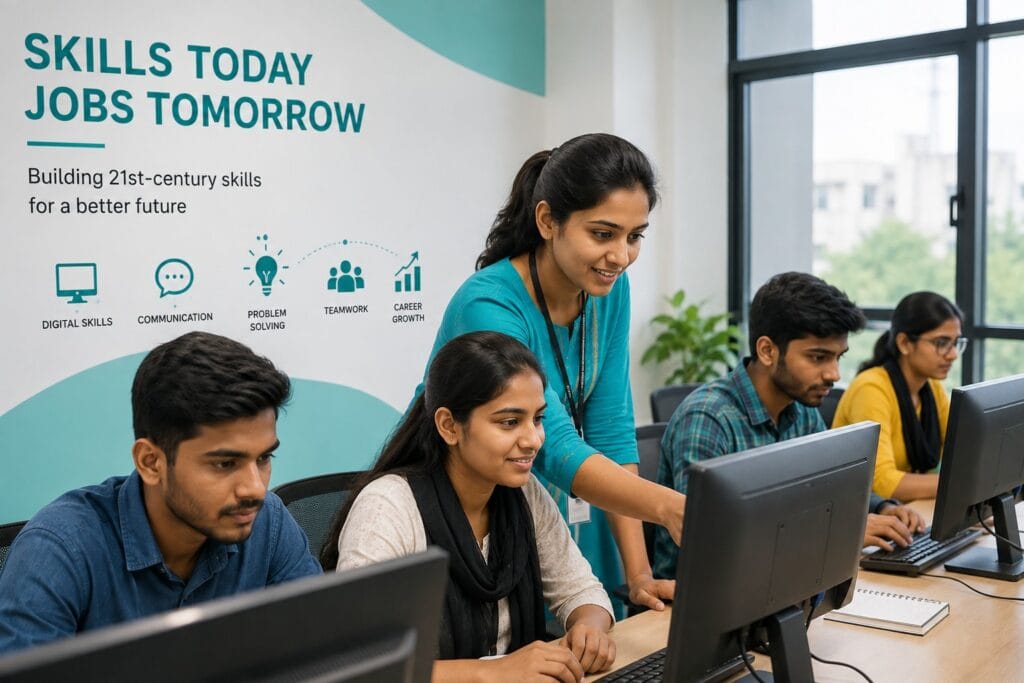
In most parts of the country, classroom learning is still not enough to meet the needs of employers. The fundamental 21st century skills like communication, digital fluency and problem-solving are still considered optional rather than essential. That’s why a huge number of youth with degrees are unable to convert education into employment.
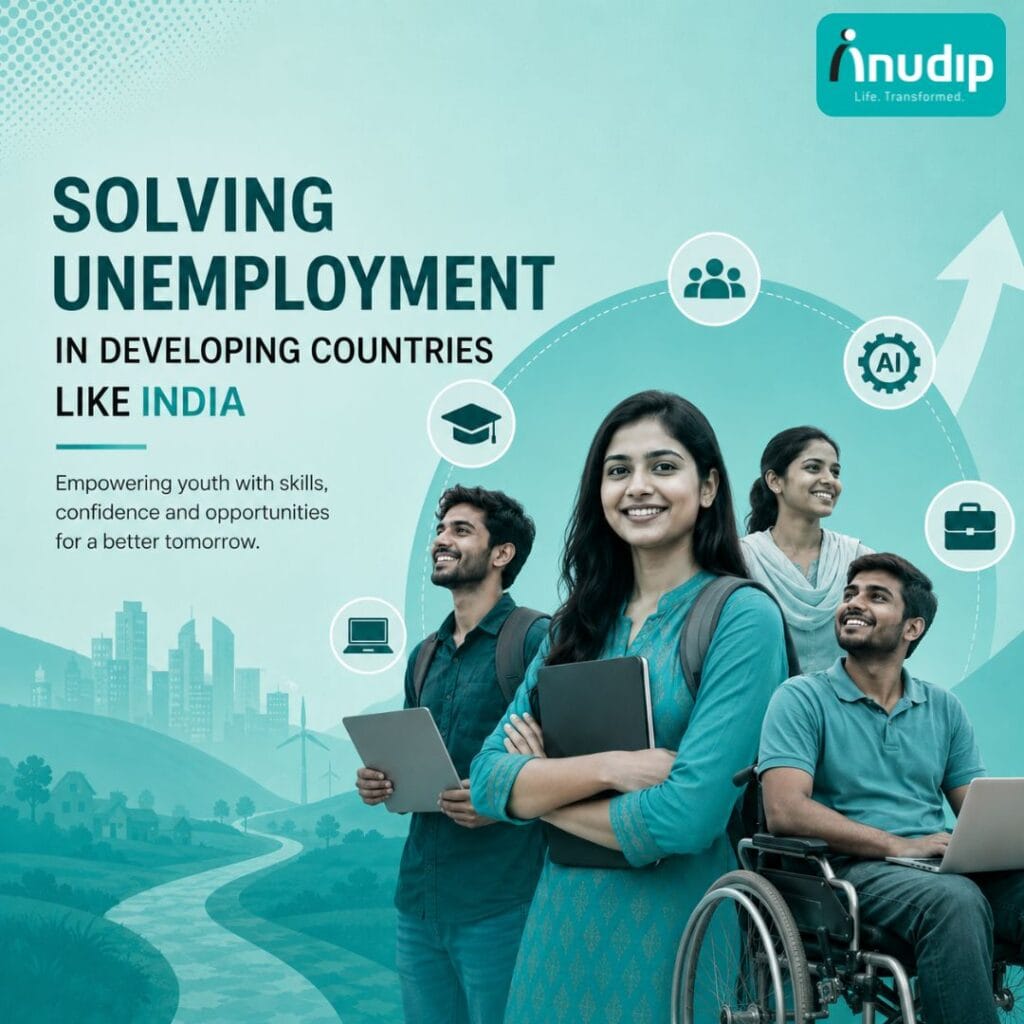
Solving Unemployment in Developing Countries Like India
Uneven access to training
Quality vocational courses are clustered around big cities, leaving rural and semi-urban India underserved. Geography alone can quietly decide who gets a chance at a stable job.
A growing digital divide
With industries increasingly moving toward automation, AI skilling is becoming a baseline expectation, not a bonus. Entire communities risk being left behind, especially women, first-generation learners and persons with disabilities who’ve had little prior exposure to technology.
Social and economic barriers
Even if opportunities are available technically, many are discouraged from pursuing ongoing work by poverty, restrictive gender norms and limited exposure to formal job markets.
Reliance on informal work
A large share of the workforce operates informally, in jobs that are unstable and low-paying, a quieter, less visible cousin of outright joblessness.
Impacts of unemployment on youth in India
The ripple effects reach way beyond individual job seekers.
Economically, unemployed youth typify untapped efficiency that the country can’t afford to refuse while competing on the universal stage.
Socially, long-term joblessness diminishes confidence and self-worth. For a household, often an unemployed family member represents limited income for everyone who lives under one roof.
And across generations, communities that struggle with chronic youth unemployment often consider that cycle to repeat, as low household incomes limit opportunity and access to the next generation.
None of this is inevitable. It’s a signal and a solvable one that the right intervention, delivered in the right places, genuinely changes outcomes.
Ways of solving unemployment in developing countries like India
If the causes are layered, the solutions have to be too.
Here’s what actually moves the needle:
Build training around real industry needs
Programmes work best when designed backward from what employers are hiring for, not forward from a generic syllabus.
Take skilling to where people are
In a rapidly changing work environment, rather than leaving young people to catch up later, youth skilling programs fostering familiarity with emerging tools give them a genuine edge.
 Comprise technology into the curriculum
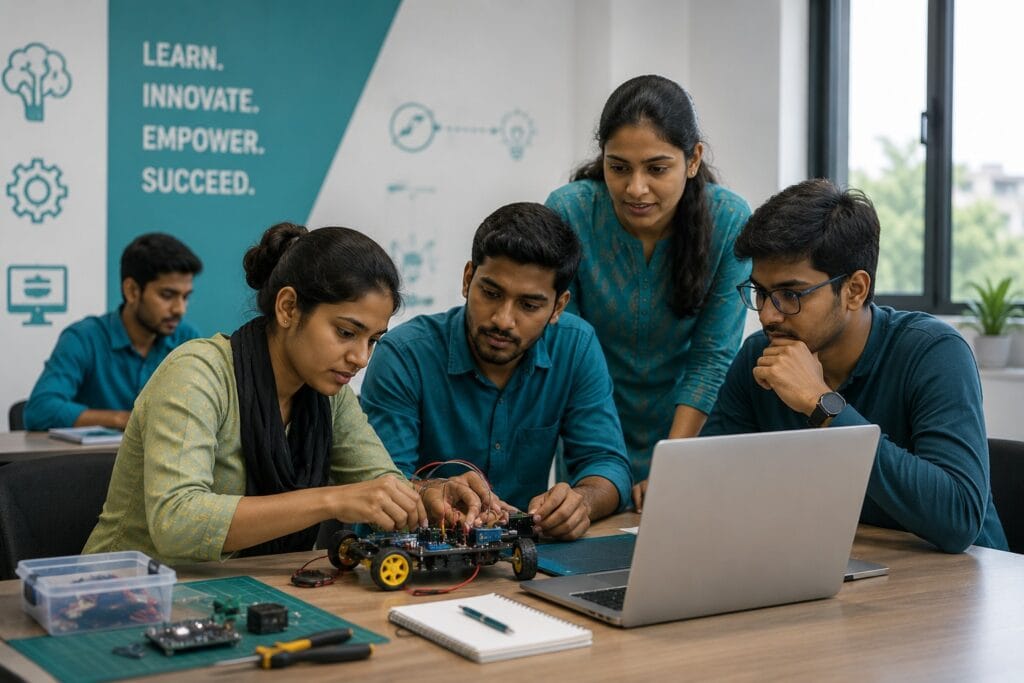
As the nature of work shifts, youth skilling programmes that build comfort with emerging tools give young people a genuine edge rather than leaving them to catch up later.
Pair technical training with confidence-building
Many first-generation learners need support believing they belong in a professional space before any skill can translate into a job.
Connect training directly to placement
Skilling without a pathway to employment is incomplete; the strongest programmes close that loop.
Skilling and empowering persons with disabilities
India comprises an estimated 8.9 million people having locomotor disabilities, the nation’s largest disability group. Still, merely 30% of those complete schooling and just 10% reach higher education. Behind these numbers are the actual blockades, like limited self-belief, an environment that’s built by excluding them and overprotective families who consider impairment a reason to shelter rather than uphold.
With the aim of restoring confidence and rehabilitation, Anudip steps in to support persons with disabilities through its SAVE (Specially-Abled Vocational Education) programme, offering IT and new-age digital skills, financial literacy, and communicative English. Additionally, HOPE (High-quality Orthosis and Prosthetics Equipment) initiative restores physical independence as a foundation for economic independence.
These initiatives prove that with the right support, self-belief, mobility, and marketable skills, disability can shift from a barrier to employment into a footnote in someone’s success story.
The Anudip model
It’s an India-based nonprofit organisation working across 22 states for almost 20 years and also has a prominent presence in the USA. Anudip spent almost two decades applying this approach to better understand underserved youth, particularly women, rural populations, and at-risk individuals. Programmes like DIYA (Digital Inclusion of Young Aspirants) build digital literacy and employability basics; FuturePro shifts learners from rote memorisation to discovery-based learning to build the curiosity, critical thinking, and communication skills employers actually look for; and AI Academy and DeepTech prepare learners for emerging technology roles.
Green skills training is fast becoming part of that same portfolio. India’s green economy is projected to reach $1 trillion by 2030 and could generate 35 million green jobs by 2047. A gap most training pipelines haven’t caught up with yet. Anudip’s green tech and climate resilience-focused skilling programme trains youth for roles in this emerging economy, giving learners a head start in a job market before it becomes crowded rather than after.
The results back up the model. Over the 19 years, Anudip has trained more than 730,000 youth, with a 70% placement rate and strong retention well past placement. Its reach is genuinely rural-first, and households connected to Anudip-trained youth have seen a 240% increase in income, proof that solving unemployment in developing countries isn’t abstract policy; it’s a model that, once built right, keeps paying forward.
There’s no single fix for unemployment in developing countries; the problem is too layered for that. But the evidence is clear on what works: training tied to real industry demand, genuine investment in underserved youth, room for AI skilling and 21st century skills, and critically, a deliberate commitment to empowering persons with disabilities rather than overlooking them.
Anudip Foundation’s track record indicates that when these pieces come together, unemployment stops being an abstract statistic and starts turning into real, sustained livelihoods and genuine hope for individuals, their families, and the communities around them.
FAQ’s
- What is the main cause of unemployment among youth in India?
The biggest driver is a persistent skills mismatch; even educated youth struggle, with graduate unemployment running at more than three times the national average, largely because training rarely matches what employers actually need.
- How does AI skilling help address unemployment in developing countries?
Youth will remain relevant in an increasingly automated economy and will be able to take up jobs that previously required automation by being skilled in the technologies that drive them.
- How has Anudip Foundation supported persons with disabilities through skilling?
Anudip Foundation has trained 13,000 persons with disabilities, placed 8000 of them in jobs, and provided 1130+ with assistive devices since 2023 in EWS and PWD.