
-By Madhuparna Roy Sukul
We have spent nearly two decades working in the spaces that most organisations overlook — the small towns, the border districts, the villages where a young person’s future is written not by ambition but by accident of birth. This is what nonprofits creating sustainable livelihoods actually look like on the ground. In that time, we have learned something that no funding report quite captures: the difference between a livelihood and a workshop is not a curriculum. It is a commitment.
At Anudip Foundation, every course we design and every young person we train is headed toward one thing: a real job, at a real company, with a real salary. Because we believe that skill without employment is a promise half-kept, and for families carrying the weight of poverty across generations, half a promise is not enough. This guide is written from that practice.
If you are a donor in India or the US, asking how to evaluate a nonprofit or choose a charity that creates lasting change, these are the six signs we would look for ourselves.
How Are Nonprofits Creating Sustainable Livelihoods?
These are skill development NGOs in India. They equip youth from small towns and remote villages, mostly first-generation learners from challenging backgrounds. The focus is market-relevant digital skills training. The goal is direct employment through structured job placement programs.
Unlike general education initiatives, these are NGOs for employment and income generation whose success metric is not a certificate issued. Instead, they uplift a family or an entire community by helping them permanently cross an economic threshold through stable income. What separates high-impact nonprofits from well-intentioned ones is a commitment to income generation programs that deliver long-term impact. For them, it’s not just about activity, but about evidence of lives permanently changed.
How to Evaluate Nonprofits: 6 Signs of a High-Impact Organisation Creating Sustainable Livelihoods
The difference between a high-impact nonprofit and a well-intentioned one lies in what happens after the training ends. It’s about whether a young person’s life has actually, measurably changed.
These six signs are what to look for when you evaluate NGO impact before donating. The signs are drawn from nearly two decades of what real, lasting livelihood programs for underprivileged youth in India look like on the ground.
1. Their Recruiter List is Real and Verifiable
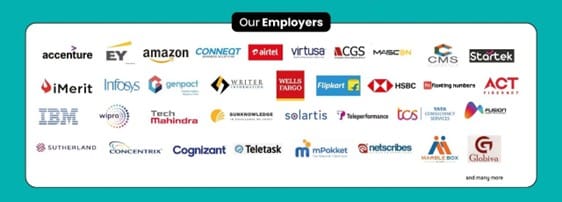
One of the clearest signals of a high-impact nonprofit is its employer roster. Not logos on a website, but named companies across sectors: IT, ITES, banking, retail, and healthcare. Ask for the recruiter list. A strong recruiter list tells you two things: that the organisation’s training is market-relevant, and that employers trust their alumni. If the list is superficial, so is the impact.
At Anudip, we take pride in our active list of hiring partners like Accenture, Capgemini, TCS, Axis Bank, Deloitte, Tech Mahindra and more. That’s a market signal that their alumni are ready for the top tier.
2.Their MOUs Drive Reach, Not Just Credibility
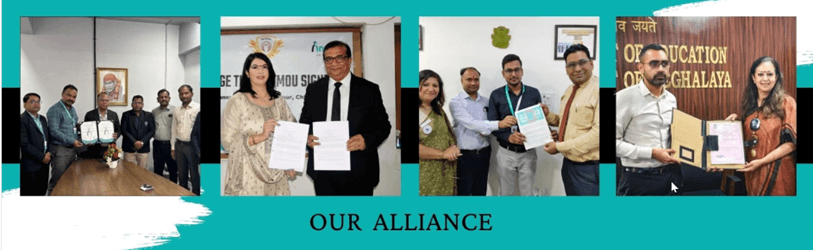
Many NGOs display partnership logos, but only a few partner with government bodies, corporates, and academic institutions that actively mobilise students into programmes. At Anudip, every MOU comes with a mobilisation commitment — built to actively find and bring in the right young people, not just to be listed on a website.
MOUs that drive mobilisation with state-level skill development missions, district-level administrations, or colleges are proof that an organisation has earned institutional trust. That trust does not come easily; it has to be earned. When a government body or university signs an MOU, they are not endorsing a logo. They are vouching for a track record.
It’s also how NGOs creating sustainable livelihoods in India reach the young people who would otherwise never have access. For example, the ones in Durgapur Government College, in a village in Odisha, or in a district where no private trainer would enter.
3.Their Curriculum Is Built With Employers, Not Just Approved by Them
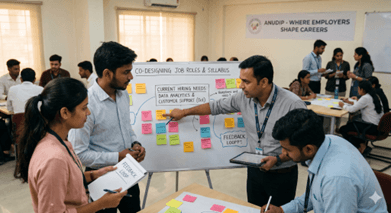
There is a difference between a curriculum that has been rubber-stamped by an industry partner and one that has been co-designed from the ground up around real job roles. Effective skill development NGOs in India go back to employers before every cohort and ask: “What are you hiring for right now?” The answer shapes the syllabus.
At Anudip, this is not a one-time exercise, because what the market needs in January is not what it needed in October. The curriculum follows the hiring signal, not the other way around.
When a young person walks into an interview in month four, she is not reciting theory — she is demonstrating exactly what the interviewer was told to look for. That is curriculum design. And soft skills carry equal weight — for young people without an academic pedigree, how they communicate and carry themselves matters as much as technical skills.
4.They Stay With Graduates After Placement
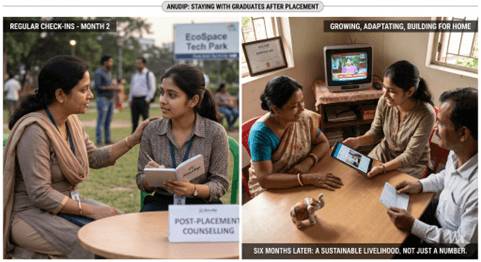
For many young people from underserved backgrounds, it’s not just about placements. It’s about how they adapt to the workplace culture, manage expectations, and build the confidence to stay.
High-impact nonprofits understand that continuation is as important as placement. Look for organisations that provide
- Post-placement counselling
- Regular check-ins
- Active intervention when a graduate is struggling.
Because a placement that does not last is not a sustainable livelihood. It is a number. The real measure is whether a young person is still there six months later — growing, adapting, and building something that reaches back home.
At Anudip, we understand that placement is vital for a sustainable future and hence, we ensure that the student is ready for the job market with complete placement guidance and monitoring.
5.They Build Resilience, Not Just Employability
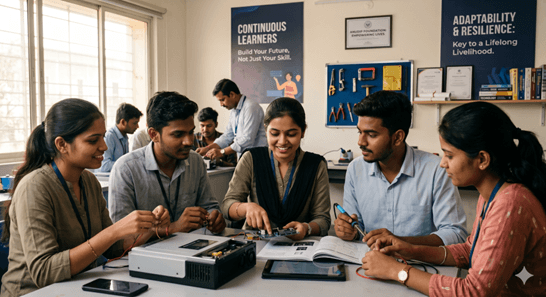
The fastest-changing job market in a generation demands more than a single skill. Nonprofits creating sustainable livelihoods do not just prepare young people for their first job. They build the resilience and intellectual curiosity to keep growing. This means exposure to new tools, encouragement to pursue certifications, and a mindset of continuous upskilling that transforms a one-time placement into a lifelong livelihood trajectory. At Anudip Foundation, we firmly believe in continuous learning and thus, we focus on long-term career growth and mentorship.
Any organisation can publish an impact report. Few publish one that is specific enough to be challenged. When you evaluate NGO impact before donating, read the annual report critically: are placement numbers broken down by sector, geography, and gender? Is income growth tracked over time, not just at the point of placement? Are dropout rates disclosed alongside success stories? Ask for impact stories that effectively showcase results and not just some vague numbers.
6.Their Annual Reports Are Specific Enough to Scrutinise
Any organisation can publish an impact report. Few publish one that is specific enough to be challenged. When you evaluate NGO impact before donating, read the annual report critically: are placement numbers broken down by sector, geography, and gender? Is income growth tracked over time, not just at the point of placement? Are dropout rates disclosed alongside success stories? Ask for impact stories that effectively showcase results and not just some vague numbers.
FROM THE FIELD: WHAT A SUSTAINABLE LIVELIHOOD ACTUALLY LOOKS LIKE
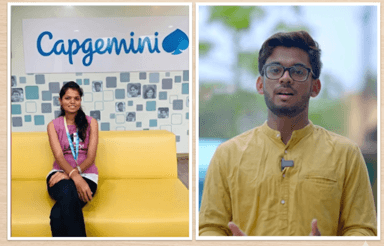
Numbers are vague; they showcase just a part of the story. The rest is in the names.
Rujuta Kailas Labade, a farmer’s daughter from Maharashtra known as the kheti girl, completed a technology-skilling programme at Anudip and joined Capgemini in Hyderabad. She returned home not as someone who had left, but with a future in her hands.
Lokeshnath Mukherjee from Durgapur enrolled in a skilling programme with Anudip at Durgapur Government College and went on to join Genpact in Salt Lake. His first salary went towards an AC for his father who couldn’t sleep through the heat.
These are real stories, just two of the many – endless names, each a transformed life, each a family changed forever. Sakshi, Kamlesh, Laxmi, Prachi, Mohit and more – Anudip continues to build thousands of stories just like these.
That is the compounding logic of nonprofits creating long-term impact vs. short-term aid. One young person with a stable income pays a sibling’s school fees, steadies a household, and buys a parent something they never had. One community that produces ten such graduates begins to see itself differently. The cycle of poverty alleviation through workforce development is not linear; it is exponential. And it starts with a single placement, a single salary slip, a single night of decent sleep.
THE BOTTOM LINE
Use the seven signs in this guide. Ask hard questions. Read the impact reports. Look for the kheti girl in the data, for Lokeshnath, for Kamlesh, for Aditya, or for the 430 students from a government college in Durgapur who now sit in MNC offices because someone built a bridge between their ambition and their opportunity.
When you find an organisation that scores on all seven, give. Because a donation to high-impact nonprofits creating sustainable livelihoods is not an act of charity. It is an act of investment. In a young person from a village. In the family they will carry forward. In the community that will watch and wonder whether their own children might do the same.
FREQUENTLY ASKED QUESTIONS
How do I know if a nonprofit is effective?
The answer lies in the numbers: look for placement rates, before-and-after income data, and named employer partnerships. A nonprofit that tells you exactly what changed in a graduate’s household income has earned its credibility.
What are sustainable livelihood programs?
They are structured programmes that train underserved youth in market-relevant digital skills, connect them to employer-linked job placement, and track income outcomes over time. The standard is simple: a graduate with a stable job that pays more than their family ever earned.
How do nonprofits creating sustainable livelihoods differ from short-term aid?
With sustainable livelihoods, you learn a skill that leads to a stable income that compounds across an entire family. That is the difference between relief and lasting transformation.