
– By Madhuparna Roy Sukul
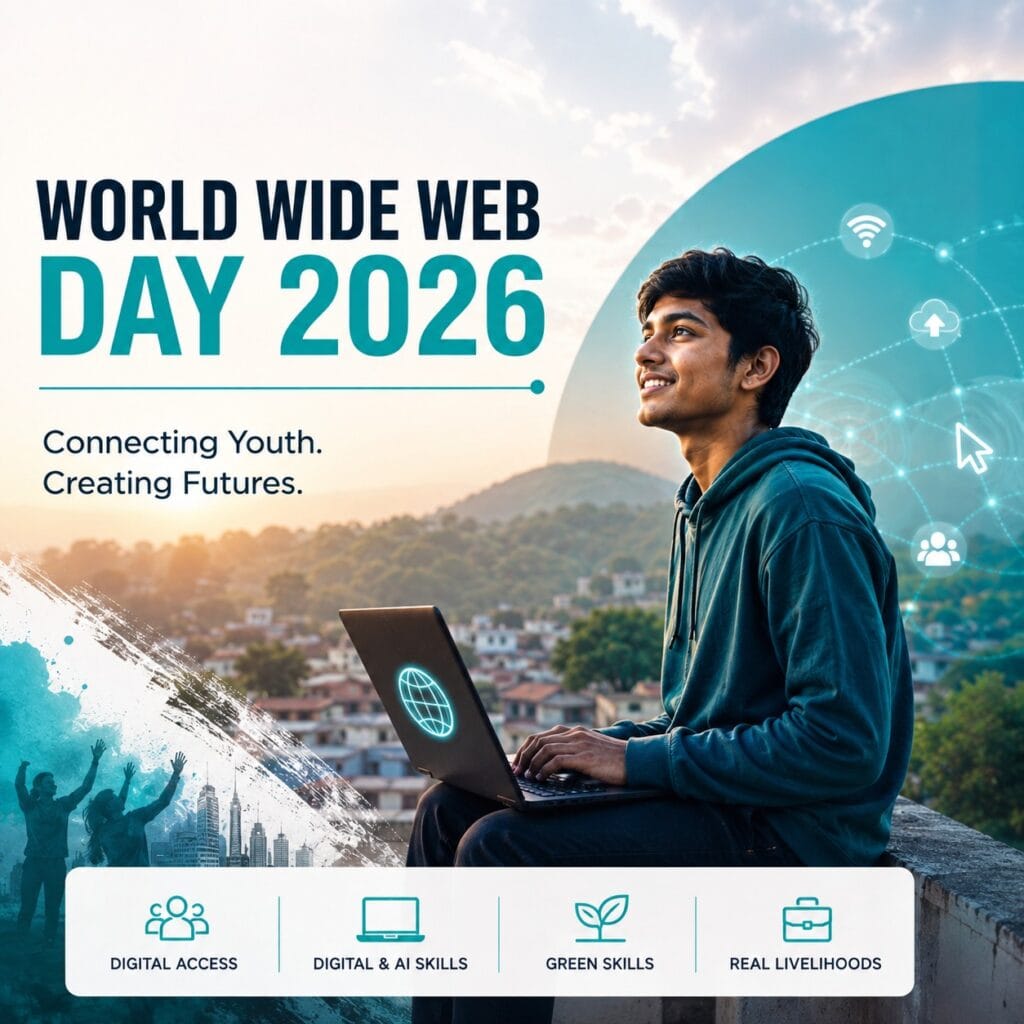
Thirty-five years ago, the World Wide Web or WWW (for example, www.xyz.com) was built to connect computers. The broader purpose of this was to connect the human population across the globe, share information and make data easily accessible across the globe. Today, it helps a teenager in a small town to pursue a coding course, a first-generation learner to land a job interview, and a family to find a livelihood they never imagined possible.
Therefore, World Wide Web Day 2026 is the perfect occasion to reflect on two simple questions. Why are there still millions of young people in India on the margins of this network? What would it actually take for the web to work for them?
The answer is turning out to be more complicated and more hopeful than most people expect.
What Is World Wide Web Day, and Why Does It Still Matter?
World Wide Web Day is celebrated every year on August 1, marking the anniversary of its invention and public availability in 1989. The day recognizes the impact of the subdomain on global communication and promotes digital inclusion for universal accessibility.
The day remains relevant not because the web is new, but because access to it still isn’t equal. Even 30 years after its launch, a significant share of India’s youth still lack the kind of access that translates into real opportunity. With rural broadband penetration at around 48% compared to 127 per 100 in cities, rural India still lags far behind in meaningful connectivity.
For most young Indians, the digital divide isn’t about owning a phone anymore, because nearly all households now have mobile internet access. It’s about weak infrastructure, slow connections, and a lack of the devices and digital tools needed to actually learn and work online.
Beyond Access: Closing the Missing Middle with Digital and Green Skills
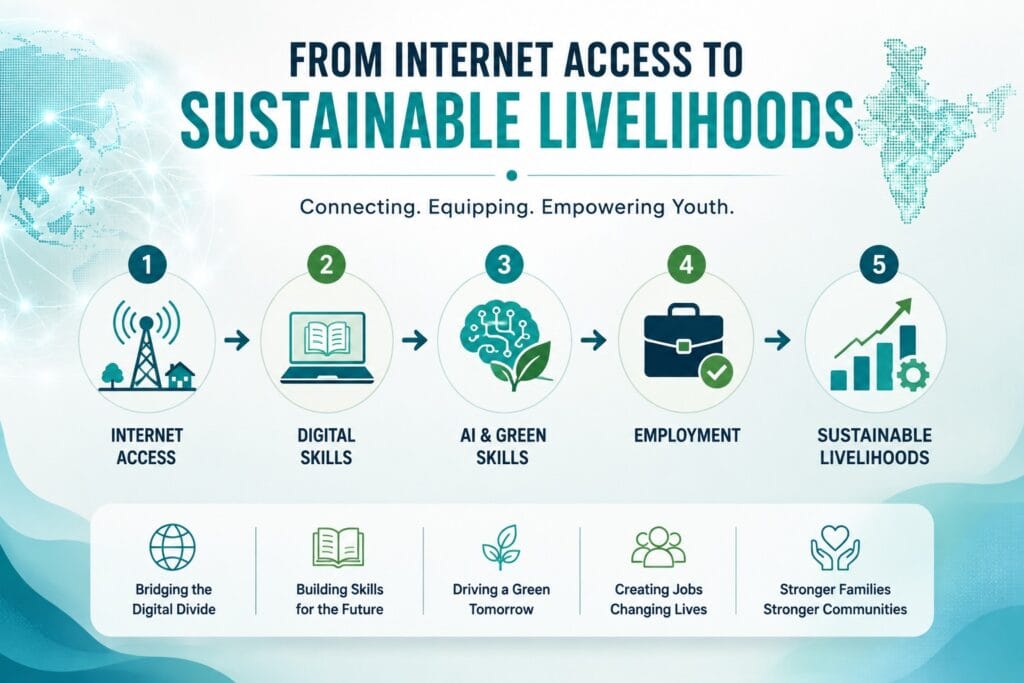
Bridging the digital divide once meant just providing devices and connections — that’s no longer enough. India recorded 886 million active internet users in 2024, yet rural youth, women, and low-income groups still lack meaningful access. What matters now is whether that access translates into digital literacy and job-ready skills, alongside a growing focus on green skills – India’s renewable energy sector is projected to generate over 3 million jobs by 2030, with broader estimates putting the country’s total green job potential at up to 35 million by 2047.
This gap between connection and career is the missing middle. Government efforts, including MeitY, NSDC, and NITI Aayog initiatives, have pushed access forward, but infrastructure alone doesn’t deliver a job offer. Closing that gap takes placement-linked skill development, job-focused digital basics, AI training, and direct industry hiring links carried through to placement, turning one skilled youth into a ripple effect across a household.
From Missing Middle to Real Livelihoods: Anudip Foundation’s Impact in Action
That missing middle isn’t just a theory, but it plays out in real households across India. Mohit Kumar grew up in the interiors of Shivaji Nagar, where his father’s ₹15,000 monthly income as an office assistant was barely enough to support a family of four. His mother stretched every rupee, while his younger sister struggled to continue her education under the same financial strain. Slowly, that weight settled on Mohit’s shoulders.
After Class 12, the decision was already made for him – forget studying further, start earning. His choices narrowed to a shop helper, an office assistant like his father, or any job that promised survival, and an extra income that could steady the household. Mohit knew that he had to follow that script, but with a four-month delay. An avid reader who noticed AI everywhere, he enrolled in Anudip Foundation’s Certificate in Digital Operations and Service with AI, drawn by how affordable it was.
Once classes began, he read beyond the modules, asked questions beyond the slides, and showed the kind of hunger trainers don’t often see. By the time the course ended, he was placement-ready. Soon the offer followed and he was selected for a systems developer role at Concentrix. As his income increased, his sister’s future steadied and his household recalculated what was possible. Read more such impactful stories here.
Multiply one Mohit by thousands, and this becomes the arithmetic of real development.
This is Anudip Foundation’s work at scale. One of India’s leading nonprofits delivering placement-linked digital, AI, and green skills training for underserved youth across IT, digital marketing, customer service, and emerging green sectors. Beyond training, Anudip supports learners through placement and long-term career growth turning digital access into sustainable livelihoods across India. For Anudip, it’s not just about providing training and job, it’s also about uplifting an entire family out of generational struggle.
Conclusion: The Web’s Next 35 Years From Access to Livelihoods
Internet access only becomes a livelihood tool when it’s paired with relevant skill training and a direct link to employers; a connection alone doesn’t pay rent. What actually changes a household’s economic trajectory is job-readiness and not just Wi-Fi, built through training that leads to real job openings and a support system that carries a learner through to placement.
That’s the real promise of the World Wide Web: not wires and browsers, but the distance it removes between people, information, and potential.
World Wide Web Day 2026 is a reminder that this mission isn’t finished. For millions of young people in India, this promise means education, employment, and a sustainable livelihood which is still being unlocked through philanthropic organizations like Anudip. That’s a future worth building access for.