
By – Madhuparna Roy Sukul
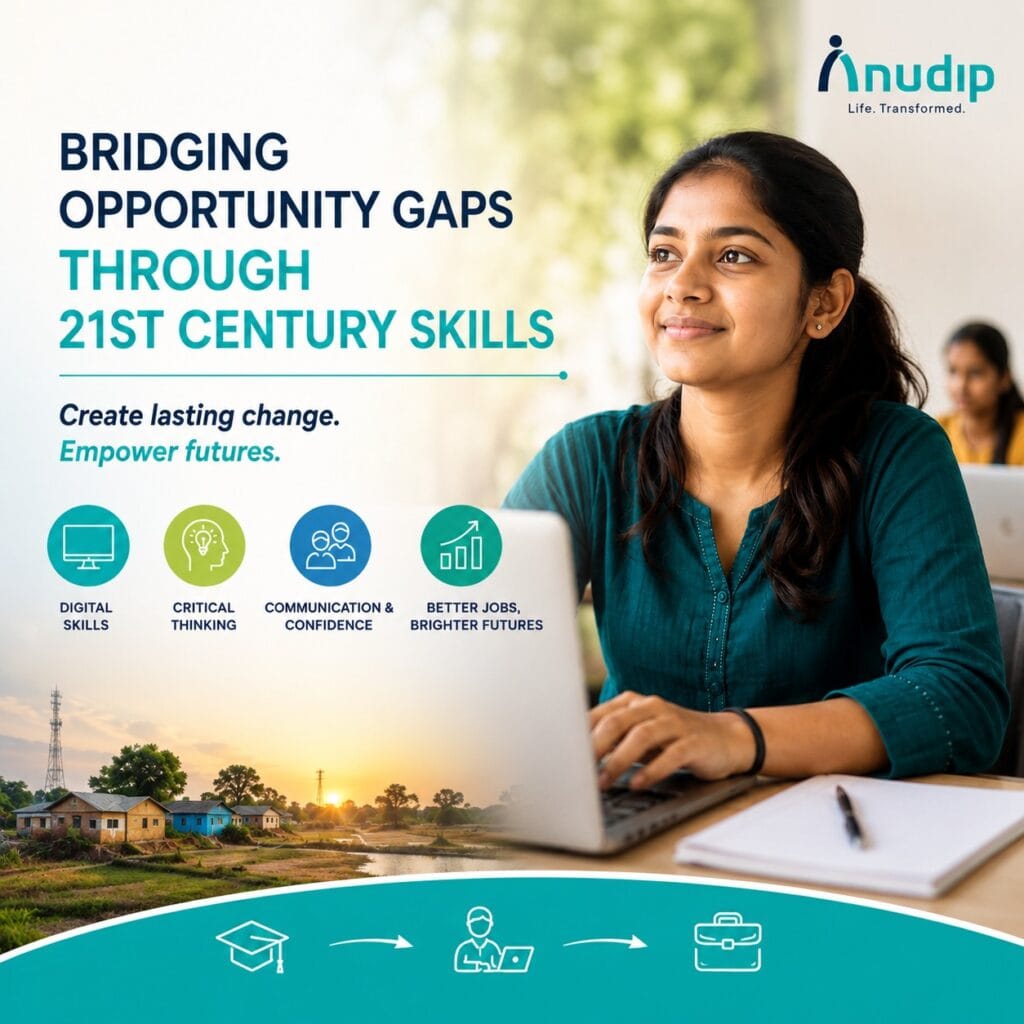
Every young person deserves the chance to build a meaningful career. Yet, for millions across emerging economies, the biggest barrier is a lack of access to the right skills. Bridging opportunity gaps through 21st century skills is becoming more important than ever as digital technology reshapes the global workforce.Many talented young people are still left behind. It’s not that they lack potential or ambition, but they are far away from the 21st century skills employers increasingly demand.
More than 2.6 billion people still don’t have access to the internet. But the bigger challenge isn’t just getting online; it’s about having the right skills. Without which, millions of people in low- and middle-income countries are being left out of the digital economy and the opportunities it creates. That’s where bridging opportunity gaps through 21st century skills comes into force. From simply being a talking point, it becomes real work through your contribution.
Understanding the Opportunity Gap
An opportunity gap isn’t a shortage of ambition. It’s about what someone is capable of and what their circumstances let them become. Imagine a student studying in a village school with no computer lab, or living in a home where no one speaks English.
The World Bank has found that fast internet access alone can raise a person’s odds of employment by up to 13%. Also, a 10% rise in broadband adoption can lift GDP by as much as 2% in lower-income economies. But access only leads you towards the opportunity.
According to the International Labour Organization (ILO), employment data puts global youth unemployment at 12.4% in 2025. This includes around 257 million youth neither working nor in school nor training. This gap isn’t only about who owns a device. It’s also about who has received the training to use it and turn a certificate into a career.
Why 21st Century Skills Matter More Than Ever
The World Economic Forum’s Future of Jobs Report 2025 predicts that 40% of today’s core workforce skills will change or go obsolete by 2030. The report is based on responses from 1,000 global employers. It also identifies the skills gap as one of the biggest challenges facing employers. As a result, 59% of the global workforce will need retraining by 2030.
LinkedIn’s Economic Graph also highlights how quickly workforce demands are changing. It reports that the skills required for a given job have already changed by about 25% since 2015. That pace is expected to double by 2027.
This means that digital literacy, AI literacy, data fluency, and adaptability are no longer optional skills. They are becoming the minimum requirements for many entry-level roles. As AI continues to reshape the future of work for underserved communities in India, the goal is to train youth for the jobs of 2030. That’s because in doing that, you don’t just help an individual, but you lift an entire community with them.
Beyond Technical Skills: How Confidence and Critical Thinking Turn Learning Into Earning
Knowing how to code rarely gets anyone through an interview alone. Based on employer feedback, the real gaps are communication, teamwork, and resilience. These are the essential employability skills that decide whether a new hire has the potential to stay and grow.
For a first-generation learner, it takes longer to build confidence than technical skills. This self-confidence is usually what makes a placement last.
One such story is about Sonali Karveer, which shows exactly that. A farmer’s daughter from a village in Maharashtra, she scored an impressive 92% in her Class 10 boards. Determined to create better opportunities for herself, she moved from a Marathi-medium school to an English-medium school to complete Class 12.
Then came 2020, when the pandemic pushed everything online; studying through it took real resilience, but she sailed through. But her major turning point was a session Anudip Foundation hosted at her college.
A language barrier nearly cost her an engineering seat. Today, she has completed an AI-powered internship in Pune and dreams of building her own company. Her journey shows how technical skills, confidence, and career readiness can change not only one person’s future but an entire family’s. Read Sonali’s full journey here.
Turning Opportunity into Lasting Prosperity
Organizations working at the intersection of education and employability show what this approach looks like in practice. Anudip Foundation has been working on this for close to two decades. They have been equipping youth in India on the other side of opportunity (mostly first-generation learners from small towns and villages) with market-aligned digital and AI skills. Alongside technical training, Anudip builds communication, critical thinking, and workplace readiness, ensuring rather than just certification.
More recently, the organization is also expanding into green skills, preparing beneficiaries for a more sustainable, resource-efficient economy. It’s proof that bridging opportunity gaps through 21st century skills keeps evolving alongside the future of work itself.
For Anudip, success isn’t a certificate. It’s whether a graduate is still working and growing even after the training ends. For this, the NGO provides them with continued post-placement support.
Multiply that across thousands of graduates, and the impact does not just remain a phrase in a report. Instead, it becomes a household with a different future than it had a year ago.
Conclusion
Put the World Bank, the ILO, and the World Economic Forum data together and you’ll notice a pattern. It indicates that connectivity without skill doesn’t move the needle much and skill without the human basics doesn’t last. Bridging opportunity gaps through 21st century skills isn’t a slogan. It’s a strategy with numbers behind it, and it plays out one household at a time.
From a village where the internet barely reached to an office in Pune, Sonali now builds intelligent systems. That’s what happens when the right skills meet someone at the right moment. This is roughly what the answer looks like for anyone wondering where their support for social impact actually compounds.
Every contribution helps create another story like Sonali’s. A young person gains more than a livelihood; they create opportunities for their family and community.