
By – Madhuparna Shukul Roy
Ask a twenty-year-old today what “the future of work” means, and you’ll likely get a different answer than you would have five years ago. AI tools now draft emails, generate reports in spreadsheets, and more. Which means the world of work is changing faster than most classrooms can teach it.
But technical ability alone won’t carry someone through that shift. What’s needed now is a more balanced skillset — blending digital skills, AI skills, and green skills with social-emotional and civic competencies, alongside the human qualities no algorithm can replace: empathy, cross-cultural communication, resilience.
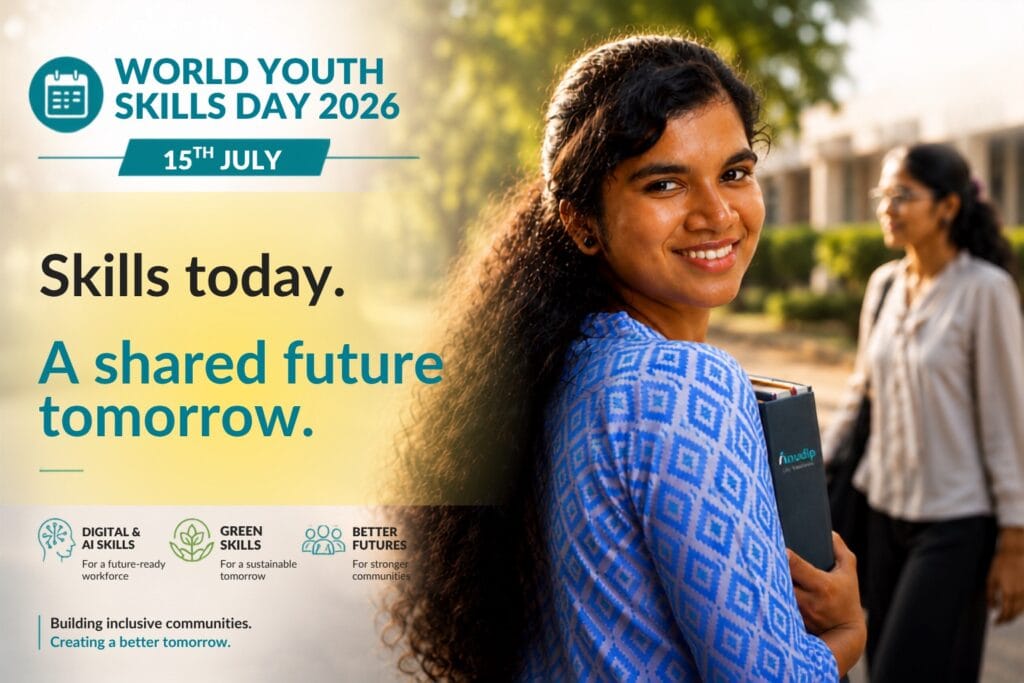
That balance is exactly what the World Youth Skills Day 2026 theme, “Skills for a Shared Future”, is built around. It’s a call to design youth skilling programmes that don’t just prepare people for a job, but for a future-ready workforce equipped to lead with empathy, work across cultures, and adapt as economies keep shifting.
For millions of young people, especially in a country as young as India, that future depends on real, sustained access to digital skilling and sustainable livelihoods. To understand why, it helps to look at exactly how fast the ground beneath them is moving.
Why the World of Work Is Changing in 2026
Artificial intelligence, automation, and the shift towards greener industries aren’t distant trends—they are already reshaping workplaces. The World Economic Forum’s (WEF) Future of Jobs Report 2025 estimates that employers expect around 39% of employees’ core skills to change by 2030, and 63% already call the skills gap their biggest barrier to growth.
For young people, especially in India, this creates a strange paradox. Jobs are being created faster than ever. The same report projects 170 million new roles globally by 2030, with 92 million displaced at the same time. But without the right training, “new jobs” doesn’t automatically mean accessible ones. This is exactly why World Youth Skills Day 2026 puts youth employability and workforce readiness at the center of the conversation.
Beyond Technical Skill: Building a Balanced Skillset
While digital skills like AI fluency are a baseline requirement these days, they’re only half the picture. A shared future asks for a more balanced skillset — one where technical and AI literacy goes hand in hand with green awareness, social-emotional skills, and the civic sense to use all of it responsibly.
According to the India Skills Report 2026, over nine in ten Indian employees are already using generative AI tools at work. It also highlights the rise in national employability from 54.81% to 56.35%. That’s real progress. But this only highlights the disparity across regions and communities.
That said, the skills employers are prioritizing this year reflect that same balance:
- AI and data literacy
- Cloud tools and cybersecurity awareness
- Green skills and sustainability practices
- Communication and collaboration skills
- Crtical thinking and problem-solving skills
- Empathy, adaptability, and lifelong learning
Green skills are following a similar path. As industries adapt to sustainability targets, understanding energy efficiency or responsible resource use is becoming as relevant on a factory floor as in a corporate office.
None of this works in isolation. A young person fluent in AI tools but unable to communicate across a team, or one who understands sustainability but not the software driving modern workplaces, still falls short of what a shared future actually demands.
Beyond Employment: Building Sustainable Livelihoods Through Skills
A job is just the beginning, not the whole story. Someone with strong digital and communication skills isn’t limited to one employer or one city. They can freelance, work remotely, or build something of their own, creating sustainable livelihoods rather than one-off employment.
That independence travels: a young person who starts earning often becomes the first in their family to save, or to help a sibling stay in school. Multiply that across a neighborhood, and skilling stops being an individual outcome. It becomes a community transformation.
But not everyone starts from the same place. Young women, first-generation learners, and youth from smaller towns face steeper barriers to digital skilling, such as lack of devices or no access to training that quietly discourage ambition. But the silver lining is the gap is closing: the India Skills Report 2026 recorded women’s employability (54%) overtaking men’s (51.5%) for the first time. It’s a proof that inclusive skilling is starting to close old divides.
The Ripple Effect: One Life Changed, Many Lives Impacted
Numbers describe a trend. They don’t describe what it feels like to live through one.
Priti Chakraborty grew up watching her father work long hours as a school bus attendant, tutoring younger students through school to cover her own expenses. She earned a seat in nursing college, then watched that dream slip away when the fees proved impossible to manage.
For many, that would have been the end. For Priti, it was a pivot point. A Certificate in Customer Service with AI course at a livelihood training center in Behala built her communication skills and AI confidence for a career she’d never trained for. She’s now a Customer Service Associate at Pemlix Technology Solutions Private Limited, supporting the family that once supported her.
Priti didn’t become a nurse. But her story proves a closed door doesn’t have to close every door. Multiply it across thousands of young people, and one success story becomes community transformation. Yet the International Labour Organization (ILO) finds that young people are roughly three times more likely to be unemployed than adults. It is proof that equal access to digital skilling is how a shared future actually becomes shared.
How Organizations Like Anudip Foundation Are Bridging the Gap
Priti’s training didn’t happen in a vacuum. It came through Anudip Foundation, a nonprofit that has spent close to two decades building placement-linked skilling models for first-generation learners across India. Since 2007, Anudip Foundation has trained thousands of disadvantaged youth this way — 91% of them from families earning less than ₹20,000 a month, exactly the households where one job can change everything.
The approach is straightforward in principle, harder in practice: pair digital skills programmes, AI training programmes, and green skills training with direct employer partnerships, so learning leads to a job rather than ending at a certificate. A significant share of learners are women, many of whom are the first in their families to access formal training of any kind. This kind of vocational training, paired with reskilling and upskilling support, is central to skill development in India and to workforce transformation on a national scale.
It’s just one example, and there are many like her proving how nonprofits can close the employability gap that formal education systems often can’t reach alone.
Why World Youth Skills Day 2026 Matters More Than Ever
World Youth Skills Day is celebrated because youth unemployment and skills gaps don’t close on their own — they need sustained action from governments, employers, and training institutions working together. The UNESCO marks the day every July 15, bringing governments, training institutions, employers, and young people into the same conversation about skills, employment, and entrepreneurship.
This year’s theme, “Skills for a Shared Future,” reflects where that conversation has arrived. AI, automation, and the green transition are changing what “employable” means faster than education systems can keep pace with. It’s a shift that takes more than technical training alone, calling for empathy, cross-cultural communication, and resilience too.
No single government, employer, or organization can close this gap alone. That’s the point of calling it shared. It takes all of them, moving in the same direction.
Conclusion
Priti’s story didn’t begin on July 15, and it won’t end there either. World Youth Skills Day isn’t asking us to celebrate Priti. It’s asking us to make sure there are more of her.