
By- Shubhodeb Bhattacharya
Not long ago, this used to be simple: finish your degree, walk into a placement drive, and land a job. In fact, that would probably have looked more or less the same for at least the next 10 years. Today, however, that version of the job market doesn’t exist for you anymore. A degree certificate on its own can no longer fetch you a job. This isn’t because degrees don’t matter anymore. It’s because the market underneath them hasn’t stopped moving. As a result, what you need now are job-ready skills to thrive in the AI economy.
AI is, in fact, the biggest reason behind that shift. According to the World Economic Forum’s Future of Jobs Report 2025, automation and AI will displace 92 million jobs globally by 2030. Meanwhile, it’s also creating 170 million new ones. However, these are built on a completely different foundation of skill than the jobs they replace. Specifically, the report projects 22% of roles to be disrupted and 39% of core skills to become outdated by 2030.
Even so, the opportunity isn’t disappearing.
In a nutshell, all of this indicates that what’s genuinely uncertain is whether you’ll have the job-ready skills to walk into what replaces it.
Read more: Solving Unemployment in Developing Countries Like India
The AI disruption is rewriting India’s job market
The role you’re preparing for isn’t static, and you’ve probably noticed this already. Globally, for instance, the fastest-growing skill demands now pair technological fluency with cognitive skills like critical thinking and problem-solving, not technical knowledge alone. Consequently, that’s reshaping the future of work faster than most curricula can keep up with.
Nor is this only a “tech jobs” story. For example, a retail, support, or back-office role today expects comfort with digital systems and AI tools that didn’t even exist in that same role ten years ago. So, while the job title stayed the same, what you’re expected to bring to it didn’t. Nearly 39% of core skills, after all, are projected to become outdated within a few years. Therefore, start planning ahead, since whatever you’re learning today has a shelf life.
Ultimately, when the target keeps moving, the real question is what you can actually do about it.
What do you need to do to stay job-ready?
Once you accept that roles will keep shifting, the response isn’t to panic. Instead, it’s to build a specific habit, such as a learner agency, or the capacity to keep acquiring knowledge independently, without waiting for someone to hand it to you.
Below are some of the skills you need to work on to stay job-ready in today’s volatile market:
- Build digital and AI literacy now, not after you’re hired. Basic fluency with digital tools and AI applications is fast becoming as fundamental as reading and writing for entry-level roles.
- Practice finding your own answers. Increasingly, employers value the ability to ask the right question and reason toward a solution over simply recalling one you were taught.
- Treat every certificate as a starting point. Since in-demand skills change from year to year, revisit what you learned in year one by year three.
- Keep learning after you’re hired. After all, staying employed and growing into better roles depends on continuously upskilling, not stopping once you’ve cleared the interview.
Altogether, none of this is easy to build on your own. This is exactly the gap structured skilling programmes are designed to close.
What this looks like in practice
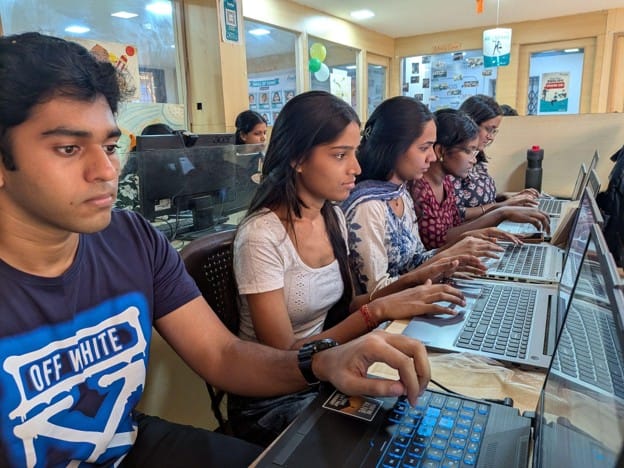
Indeed, none of this is easy to build alone and that’s the practical gap. Anudip Foundation‘s job-ready skills training in India responds to that gap. Specifically, it offers structured, industry-aligned skilling programmes, designed to turn theory into job-ready skills.
Skilling programmes at a glance:
DIYA
Builds digital workplace skills and placement support for first-generation learners from non-technical backgrounds, many with limited prior exposure to technology or professional environments. It develops digital literacy, communication, and workplace readiness for roles across retail, IT, and customer service. This comes with a deliberate focus on the confidence and adaptability needed to stay resilient as those very roles keep evolving.
DeepTech
Likewise, this programme delivers core technical skills and placement support for undergraduates and graduates from technical backgrounds. Here, learning takes shape through industry-aligned, project-based training in full-stack development, data analytics, and AWS Cloud Computing. This approach builds a portfolio of real work rather than just theory.
Green Skills
This programme, meanwhile, trains women and youth aged 14+ across ITIs in India in in-demand trades like Solar PV installation and Electric Vehicle mechanics, followed by career counselling and ITI admission guidance for those who’ve completed Class 10 or 12.
STEM (School Transformation Program)
It equips school teachers with application-based STEM methodologies and sets up STEM labs in government schools. Being the furthest-upstream piece of the puzzle, it prepares teachers for the shifting economy their students will enter. The aim of the programme is to build the next generation of professionals ready to navigate that shift confidently, long before they reach a placement program.
An integrated pedagogy runs underneath all four:
- AI Academy weaves foundational AI literacy into the learning journey via tools like ANU AI and iChat.
- FuturePro’s discovery-based approach builds 21st-century skills through peer learning, regular industry visits and mock interviews.
Summing up, the skills will keep shifting and the habit of chasing them is what actually gets you hired, kept up, and grows within the evolving market economy.
Read more: World Wide Web Day 2026: Celebrating Internet’s Power by Providing Access to Every Youth in India

The bottom line
In reality, the jobs aren’t disappearing; they’re changing shape faster than most training catches up with.
The role you enrolled for is already outdated. Your ability to keep learning isn’t. Start building the job-ready skills the market is actually asking for today, keep updating them as roles shift. The job that’s waiting is far more likely to be waiting for you.
FAQs
Is it true that there are no jobs for freshers in India right now?
No, the real gap is a mismatch between evolving roles and current skillsets, not a lack of open positions.
What skills are most in demand for students today?
Skills like digital and AI literacy, communication, critical thinking and independent problem-solving are most in demand.
Does upskilling stop once I get hired?
Not at all! With nearly 40% of core workforce skills expected to change by 2030, upskilling after you’re hired is what keeps you relevant.