
By Madhuparna Shukul Roy
Somewhere between the headline that AI will take your job and the headline that AI will change your life for the better, most people are just trying to figure out what it means for Monday morning.
That uncertainty isn’t unreasonable. Generative AI tools have seen a faster shift from their introduction to being a daily habit than any other technology before. Before you think, it has reached the majority of the world’s population within a few years of ChatGPT’s launch. The global labor market shows the same speed. According to IMF staff analysis in Jan 2026, in the USA, job postings mentioning AI-related skills climbed to almost 5% in 2025 compared to 1% in 2025.
While AI is clearly changing the way people work, the question is, who benefits from that change and who is left behind? For the youth joining the current workforce, especially those with no access to elite universities or corporate training budgets, there’s more silence than direct answers. For them, it’s about getting a genuine opportunity to learn the tools shaping the jobs they’re competing for.
Why AI Is Often Seen as a Threat and Why That Fear Is Incomplete
The fear is understandable as automation has always displaced certain kinds of work and generative AI is unusually good at tasks once considered safely human. This includes tasks like drafting, summarizing and even basic coding. Pew Research has tracked rising public unease alongside rising AI use, with more people now saying they feel concerned than excited about its spread.
The IMF study also noted that in occupations highly exposed to AI where there’s little room for human intervention, regions with faster AI-skill growth recorded a 3.6% lower employment rate five years later. This pattern hit the young, early-career workers hardest.
While job loss is indeed a concern, labor market research from Stanford’s AI Index shows AI-related skills appearing in a small but rapidly growing share of job postings worldwide. This demand, it says, will see a rising trend every year. So, it’s not actually a shrinking job market, but a new job market with some tasks disappearing, others emerging, and a widening gap between those equipped to work with AI and those competing against it.
Therefore, it’s not just about AI adaptability or job availability; it’s also about responsible use of AI. A technology has the potential to make millions of jobs need protection against bias, transparency and fair access, and not just faster models. While appreciating AI’s capabilities is important, it’s also important to focus on bridging the employability gap.
AI Literacy and Market-Aligned Skills: Closing the Employability Gap
AI does not just automate tasks, but it also helps sharpen abilities. Studies indicate that AI tools allow workers with less experience to produce results that once required years of specialized training. This is visible in customer service, software development, and data-heavy roles and this is possible because AI literacy isn’t about heavy data analytics knowledge. But it’s about using an effective prompt, evaluating the output and pairing it with the right judgment.
In practice, AI literacy today means:
- Using good prompts and evaluating their output critically.
- Blending AI-generated work with human decisions and context.
- Understanding where AI genuinely helps and where it doesn’t.
- Using the data and digital tools confidently.
- Understanding the importance of continuous learning and that tools evolve faster than most curricula do.
None of this requires an engineering degree. All it requires is exposure, practice, and someone willing to teach it early. That’s precisely where the employability gap opens up – not a gap in degrees or years of experience, but in who has had a fair chance to build market-aligned digital skills alongside their existing ones, and who hasn’t.
The Ripple Effect: What Happens When AI Training Reaches the Right Person
Vaishnavi Gaikwad’s family farms land in Pandharpur, Maharashtra. Growing up, she watched her father’s long hours and the uncertainty that comes with farming for a living, and it shaped what she wanted to study. She chose computer science, partly hoping technology could eventually help farmers like him. It was a goal that’s less unusual than it sounds, as agriculture becomes one of the many sectors quietly being reshaped by data and digital tools.
Through a partnership between her college and Anudip Foundation, she completed an IBM SkillsBuild course covering technology fundamentals, data analysis, and Design Thinking — the kind of foundational digital and problem-solving training that increasingly underpins AI literacy, whatever specific tool a workplace ends up using.
She’s since been placed as an Intern Trainee at CMS. While it’s a modest first role by title, it had a huge impact on her self-confidence. It’s the beginning of an income her family didn’t have before, and proof, to everyone watching from her village, that this path is real.
How Organizations Like Anudip Foundation Are Bridging the AI Employability Gap
Vaishnavi’s placement happened not just through her willpower, but through a structured pathway facilitated by Anudip Foundation. The nonprofit, working across India, bridges the gap by pairing digital and AI-adjacent skilling with direct placement support for first-generation learners and young women who rarely get a second chance at this training.
Since 2007, it has trained thousands of students this way, most from modest-income families, exactly the households where one placement can shift what’s possible for an entire family. For Anudip, it’s about closing the employability gap through structured access, such as a curriculum, a mentor, and an employer willing to hire on demonstrated skill rather than pedigree.
Industry partnerships, like the one that brought IBM SkillsBuild into Vaishnavi’s college, do the heavy lifting by aligning training with what employers actually need, the same access that responsible AI adoption should mean in practice.
World AI Appreciation Day: Appreciation as Access, Not Just Admiration
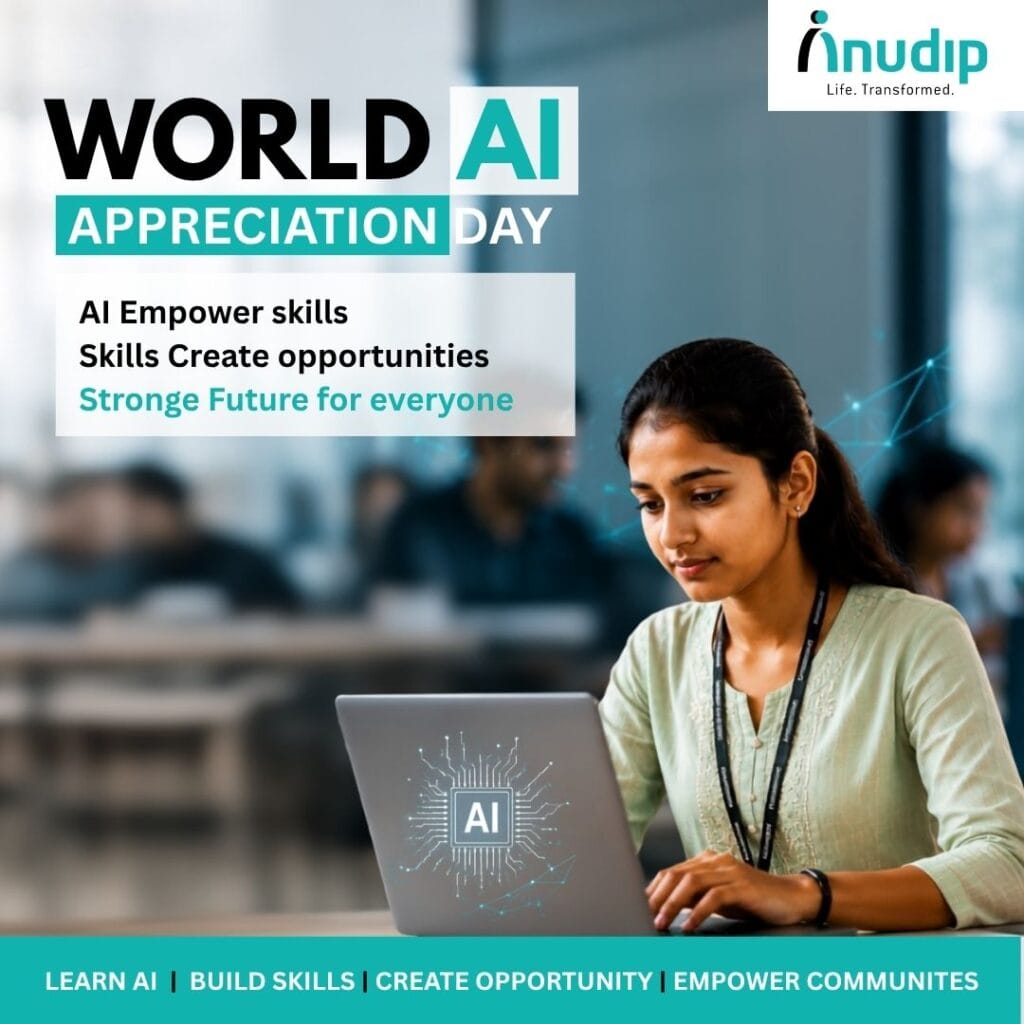
That structured access is really what World AI Appreciation Day, observed each July 16, is asking people to think about. It’s easy to appreciate AI as a technology, such as its speed, its fluency and the sheer novelty of talking to a machine that talks back. But it’s harder, and more useful, to appreciate it as a decision like who gets trained to use it, and who’s left to compete against it instead.
Vaishnavi’s story is a small answer to that question. Appreciating AI, in the end, might mean less admiration and more access.