
By – Shubhodeb Bhattacharya
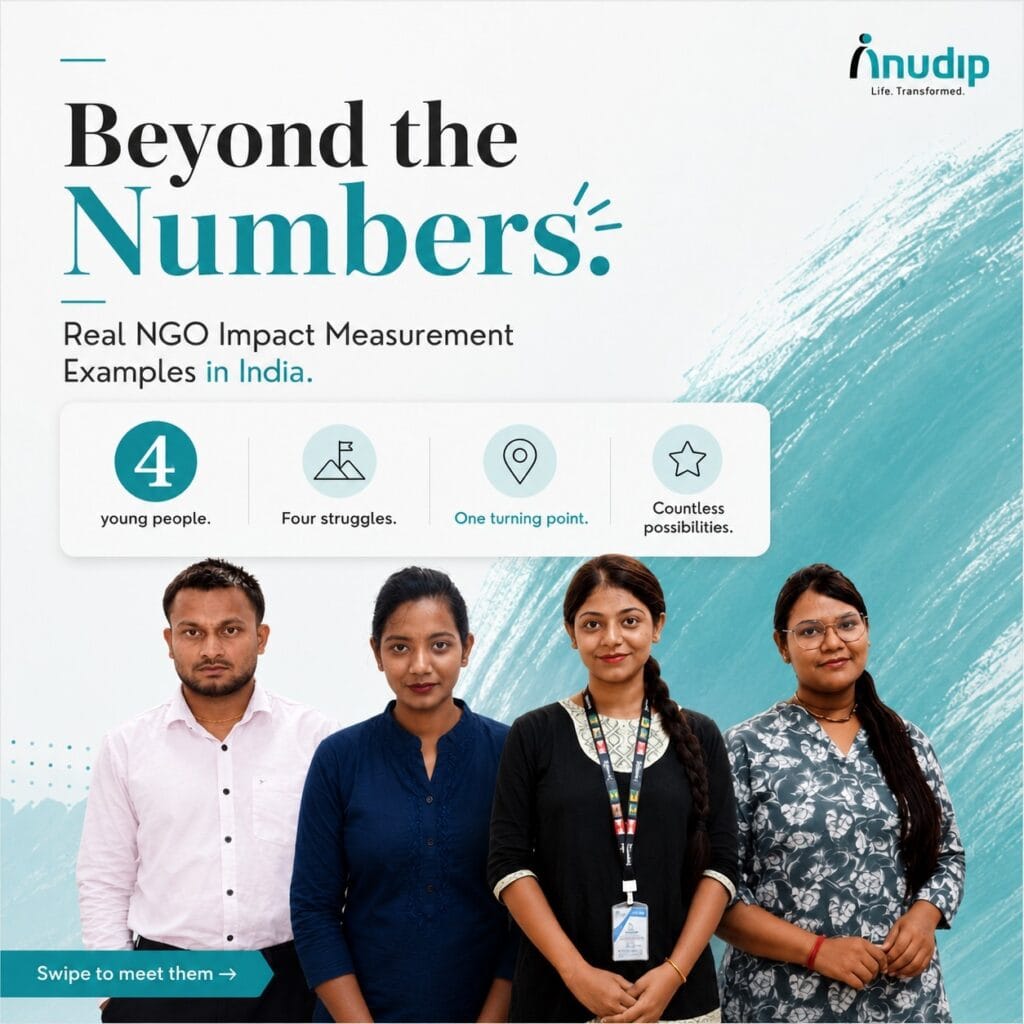
Every annual report has a number for it, highlighting jobs placed, families supported, income generated, and so on. But numbers rarely explain what changes inside a household when a first-generation learner brings home a paycheck. In a humble family, that first salary can be the difference between skipping a meal and eating well, between a father working through pain and finally resting, between surviving a month and actually saving for one. That’s exactly why the most convincing NGO impact measurement examples in India aren’t spreadsheets; they’re individual stories, each with its own unique challenge: a vegetable seller’s son determined to lift the weight off his father’s shoulders, a girl from a remote village where electricity never reached, a young woman whose nursing dream was deferred but never let go of, and a rickshaw puller’s daughter who refused to let her father’s fading strength decide her future.
Since 2007, Anudip Foundation has been working relentlessly to transform the lives of those most in need, i.e., marginalized youth across India. We’d like to highlight four stories of beneficiaries from our latest batch, whose journeys show how skilling one young person sets off a ripple effect that reaches an entire household.
Why NGO Impact Measurement Examples in India Start With Real Lives
When we talk about numbers associated with an NGO , the first thing that comes to our mind is the Annual report. In reality, reports showcase only placement rates and average salaries; what they cannot reveal is why those numbers matter. How a ₹12,000 monthly salary draws the line between a family scraping by and a family finally breathing easy. Grounding education in India results in individual stories that turn a statistic into proof of real change. It also helps to see these outcomes against the wider backdrop: UDISE+ data cited by India’s Ministry of Education tracks enrollment and school infrastructure nationwide, while the World Bank continues to partner with India on strengthening school and technical education.
Four Journeys, One Common Thread
Parna Naskar: A Rickshaw Puller’s Daughter Finds Her Own Path
Parna Naskar grew up in a family where every rupee mattered. Her father, a rickshaw puller, spent his life pedaling through long hours, carrying the weight of the household on his own shoulders. But age caught up with him. His strength began to fade, and with it, his earnings, leaving the family’s finances shakier than ever. Parna wanted to change her family’s fate, and it was a friend who first told her about Anudip Foundation. She signed up for the Certificate in Customer Service with AI course at Anudip’s Behala centre. Parna worked on her communication skills and built the confidence to use AI tools in a modern workplace. The effort turned into a role as a Customer Service Associate at Pemlix Technology Solutions, a milestone that meant far more than just a paycheck; it was the moment her father’s years of sacrifice finally paid off. Today, Parna covers a share of her family’s expenses and is saving up for something she’s long wanted to do: repair the family home.
“Seeing my parents smile with hope instead of worry, that’s the real reward,” says Parna.
Rintu Roy: From a Vegetable Cart to a New Beginning
Growing up in Nandigram, Rintu watched his father push a vegetable cart from dawn to dusk, just to keep the family fed. That daily grind was reason enough to want something different. So every day, he made the 120 km round trip from Nandigram to Haldia to pursue the Certificate in Customer Service with AI at Anudip Foundation. The course opened the door to a job at mPokket as a Digital Customer Specialist. On its own, ₹14,000 a month doesn’t sound like much, but stacked alongside his father’s earnings, it’s given the family a cushion they never had, enough to cover costs that once felt out of reach. Moving to Kolkata alone wasn’t easy, but his mentors stood by him, and that made all the difference. Today, Rintu consistently hits 100% of his targets and has earned recognition at work. With his own savings, he bought his father a motorcycle. So that the man who once carried the family’s weight alone no longer has to walk for miles and can keep selling his vegetables with a little more ease.
“Watching my father’s face when I handed him the keys, that’s when I knew all the hard work was worth it,” says Rintu.
Paramita Bera: Rising From a Remote Village in West Bengal to a Career in Kolkata
Paramita grew up in a remote village 10 km interior from Nandigram, in a household of five: her parents, two sisters, and herself. Her mother is a housewife, and her father, once a factory worker, suffered two injuries that left him with spinal cord damage. He still works there today, but with limited capacity. Mounting medical bills only added to the strain. Determined to support her family, Paramita, a 12th-pass student enrolled in the Certificate in Customer Service with AI course at Anudip Foundation. The training gave her the confidence to move to Kolkata alone, landing her first job at ONS Solution before moving on to Telemark, where she now works as a telecaller earning ₹12,000 a month. A life once as dark as her unlit village now shines. Paramita lives independently in the city lights of Kolkata, sending money home each month to support her family.
Priti Chakraborty: The Nurse She Couldn’t Become, The Career She Built Instead
Priti Chakraborty grew up watching her father work tirelessly as a school bus attendant, with financial struggle a constant part of life. From Class IX, she gave tuition classes to fund her own education, determined never to be a burden on her parents. Her dream was to become a nurse, and she secured admission to nursing college but couldn’t afford to continue, one of the most painful moments of her life. She enrolled in the Certificate in Customer Service with AI course at Anudip Foundation instead, building communication skills, confidence, and command of AI tools. That effort paid off with a job as a Customer Service Associate at Pemlix Technology Solutions. The girl who once tutored children to support herself now supports her family. “I couldn’t become a nurse, but I built a career I’m proud of,” says Priti.
Four different hardships, yet the same turning point repeats: a young person walks into a classroom carrying their family’s weight and walks out with a way to lighten it. That repetition is what makes these stories worth highlighting together. This achievement can never be shown in any reports.
What These NGO Impact Measurement Examples in India Reveal
Take a close look at all four stories. There’s a pattern: each family’s income didn’t just grow; it stabilized. A parent’s failing health or fading strength stopped being a financial cliff edge. That shift is what separates the best NGOs for skill development in India from programs handing out certificates without a job at the end. It’s also why AI education in India matters at the entry level, as customer service roles increasingly expect comfort with AI tools.
This is Anudip Foundation’s model in action, pairing digital and AI training with direct employer partnerships, so a certificate never has to sit unused. Behind that model are numbers that tell their own story: over 730,000 youth trained in 19 years, across 22 states, with more than half, 54%, coming from rural India, 29% from semi-urban towns, and 17% from urban centers. The real test, though, isn’t how many people walk through the door; it’s what happens after. A ~70% placement rate and 83% six-month job retention mean the training holds up once the certificate is in hand. And with women making up 53% of beneficiaries and household incomes rising by up to 240%, the impact reaches well past the individual, straight into the home.
Conclusion
Rintu, Paramita, Priti, and Parna each started in a different corner of West Bengal, carrying a version of the same struggle. What connects them isn’t luck; it’s access to the right skills at the right moment. That is what the most honest NGO impact measurement examples in India look like: not a percentage in a report but a father who no longer walks for miles or a mother whose prayers were answered.
Frequently Asked Questions
- How do nonprofits measure real-world impact beyond placement numbers?
Meaningful measurement looks at individual outcomes: a first-generation learner securing stable employment or breaking a cycle of financial hardship, as seen in Anudip Foundation’s beneficiary stories.
- How does Anudip Foundation build AI skills for underserved youth?
Anudip offers courses like the Certificate in Customer Service with AI, building AI-tool fluency alongside communication skills for entry-level digital roles.
- What should families look for in a skilling nonprofit?
Strong nonprofits combine training with employer partnerships, ensuring learners move from certification to real, sustained employment.