– By Shubhodeb Bhattacharya
Before sunrise in Kandivali, Mumbai, Suraj Mahendra Prasad Yadav’s father and younger brother would set out to supply the day’s newspapers. His elder brother managed a medical store, and the women of the house held the family together at home. It was a household built on steady, early-morning work. Suraj completed his B.Com within it, and by every conventional measure, a career should have followed.
It did not, at least not straight away. Like many first-generation graduates, Suraj had the qualification but not yet the confidence or the English communication skills employers expected. His situation reflects a wider pattern across emerging economies, where wider access to education has not always translated into wider opportunities for youth.
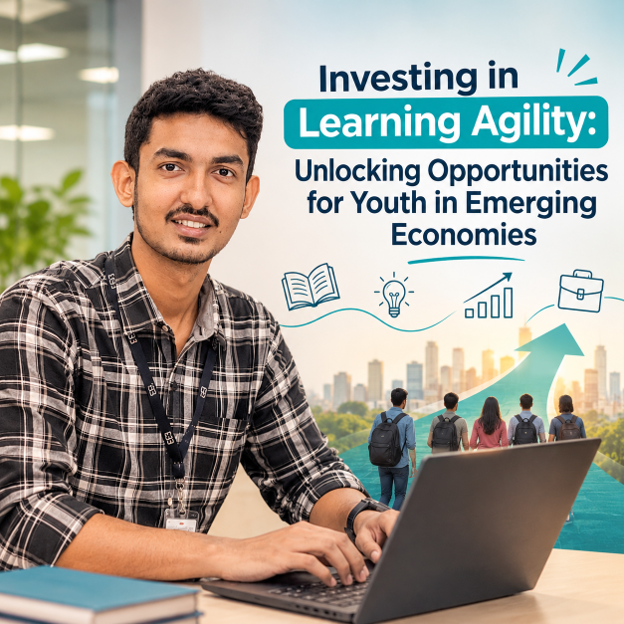
This article follows Suraj’s path to examine why investing in learning agility, the ability to learn, unlearn and adapt, offers donors one of the most lasting forms of impact.
A Degree in Hand, a Door Still Closed
India has one of the largest young populations in the world, and every year a new cohort of graduates enters the job market. A degree alone rarely secures a place in it. Employers increasingly look for people who can communicate clearly, solve unfamiliar problems and keep pace as tools and processes change. Many young people from low-income or first-generation households have had little chance to build these capabilities. This is why opportunities for youth in India remain unevenly distributed even as the economy grows.
For Suraj, the gap was specific. He understood commerce on paper. He had not yet learned to present himself, to speak with confidence in English, or to apply his knowledge to the data-driven work that modern offices depend on. This is where youth skill development in India often falls short: it teaches content, but not always the adaptability that turns content into a career. Closing that gap calls for a different kind of learning.
Why Learning Agility Is the Skill Behind Every Other Skill
Technical skills have a shelf life. Software updates, job roles shift, and entire functions are reshaped by automation and artificial intelligence. What keeps its value is the ability to learn quickly and carry that learning into new situations.
The OECD’s Skills Outlook 2025 makes a related case, arguing that investing in 21st-century skills such as critical thinking, creativity and collaboration is central to widening opportunity, especially for those who start with fewer advantages.
For young people in emerging economies, learning agility works as a form of insurance. A learner who knows how to learn is less exposed when a particular job disappears. That learner is also better placed when new opportunities for youth appear in growing sectors. For donors, this changes the calculation. Funding a single course produces a single skill. Funding the capacity to keep learning produces returns that build across an entire working life.
The practical question is how that capacity is actually built inside a classroom.
Learning That Starts With a Question
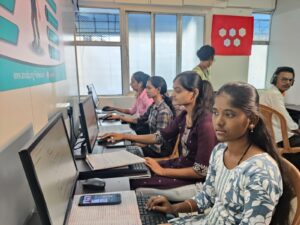
At Anudip Foundation, Suraj enrolled in the Advanced Excel programme. The technical goal was clear: data handling and spreadsheet analysis, skills in steady demand across IT and IT-enabled services. How he learned mattered as much as what he learned.
In Anudip classrooms, trainers act less as lecturers and more as facilitators. Learners work through practical problems, ask questions before they are handed answers and test their reasoning on real tasks rather than memorising steps. The approach builds curiosity and critical thinking alongside technical skill. For Suraj, it also made room to work on what had held him back most. Guided by mentors who understood the barriers first-generation job seekers face, he practised his communication and steadily built his professional confidence.
In his own words, the change went deeper than software. “It wasn’t just about learning Excel,” Suraj says. “It was about learning to believe that someone like me could belong in a place like such a big organisation.” That shift in belief is often the hardest outcome to measure. It is also the one that sustains every other gain.
Widening the Pathway From Classroom to Career
Suraj joined one of the most eminent organisations in India as an International Trade KYC Analyst. The role calls for precision, analytical ability and confident client interaction.
His journey shows that well-designed training can do more than prepare someone for an interview. It can prepare them to grow once they are inside an organisation. Individual journeys like his still depend on broader opportunities for youth being in place, and two questions come up repeatedly among those supporting youth employment.
How to Increase Job Opportunities for Youth Over the Long Term
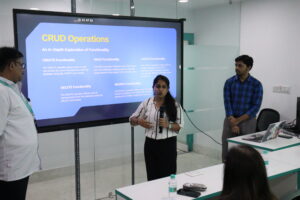
Lasting progress tends to rest on three conditions:
Training has to match what employers need
Teaching methods have to build adaptability rather than rote knowledge
Training providers need continuing links with industry
Creating economic opportunities for young people is not just about training them for today’s jobs. It is about teaching them how to keep learning on their own, so they can keep up as roles and industries change.
Reach matters just as much. Suraj’s barriers, confidence and communication, are typical of a first-generation learner. Other young people stand at different starting lines. Some are held back by a syllabus the market has outgrown, others by social expectations, disability or distance from India’s big cities.
The Young People Anudip Reaches, and the Goals Behind the Work
Anudip’s causes worth funding describe the young people its work is designed to reach:
First-generation learners, who arrive with little confidence, limited communication skills and no exposure to digital tools or a formal workplace
Disrupted tech graduates, whose degrees the market has outpaced and who need learning agility to keep growing as AI reshapes work
Women from the margins, often with no work experience and little family support to begin earning
Differently abled youth, whose path into formal work often begins with earning their families’ trust
Polytechnic students, guided towards the solar and EV skills that tomorrow’s economy will need
Students and teachers in non-metro schools and colleges, who are usually the last to receive new curricula or digital exposure

Each of these young people needs what Suraj once needed: an environment that builds skill, confidence and the habit of adapting. When that need is met, the change is felt beyond a single classroom. A first income, a stable job or a school reached for the first time each contributes to commitments the world has made together.
The Sustainable Development Goals Anudip works toward the following:No Poverty (SDG 1), Quality Education (SDG 4), Gender Equality (SDG 5), Decent Work and Economic Growth (SDG 8) and Reduced Inequalities (SDG 10).
These goals describe the scale of the task, and Suraj’s journey shows what progress towards them looks like in a single life.
From Learner to Mentor: Where the Investment Leads
Suraj has been named “Star of the Month” four times in a single year at that emiment organisation. He verifies complex trade documents, onboards international clients and now mentors new joiners who are starting where he once stood. The learner has become the mentor, and what he was given is already being passed on.
For donors, this may be the clearest measure of what an investment in learning agility produces. It does not end with one placement. It carries forward into families, workplaces and the next group of young people looking for a way in, whether a first-generation graduate in Mumbai or a polytechnic student in a small town.
Expanding opportunities for youth in emerging economies depends on many actors, but it begins with a decision to invest in how young people learn.
Readers who want to understand how such support is directed can find more on Anudip’s donors page.
FAQs
1. What is learning agility and why does it matter for young people?
Learning agility is the ability to pick up new skills quickly and apply them in unfamiliar situations. As job roles change with technology, it helps young people stay employable long after their first job.
2. Who does Anudip Foundation work with?
Anudip works with first-generation learners, tech graduates whose skills the market has outpaced, women from marginalised communities, women trafficking victims, differently abled youth, polytechnic students and learners in non-metro schools and colleges.
3. How does Anudip’s teaching approach build adaptability?
Trainers act as facilitators. Learners solve practical problems, ask questions and build reasoning through hands-on tasks instead of memorisation.