– By Shubhodeb Bhattacharya
This is a common situation for every hiring manager: the CV looked impressive, ticking every box, the interview was smooth and the offer was signed. After three months, the new hires are still trying their feet with the process, tools, the pace and the way the team works. The degree was real, but the individual was not.
The hiring manager never sees the candidate that the process has already filtered out. In the same pile of applications was a young graduate from a small town hundreds of kilometres away from a metro city whose CV never made it to the shortlist. His college name didn’t appear in the applicant tracking system, and his experience looked thin on paper, too. But put him in front of a real problem, and he breaks it down, asks the right questions and quickly learns what he doesn’t know yet.
For nearly two decades now, Anudip Foundation has been working on both sides of this story. On one side, employers seeking reliable entry-level talent.
What Is Skills First Hiring?
Skills first hiring is a recruitment approach that selects candidates based on their performance and growth potential, rather than their educational qualification, institution studied or work experience.
This process tends to alter four things:
- From pedigree to evidence: Decisions are based on practical tasks and simulation of actual work, not on what the resume shows
- Talent pools – narrow to wide: All candidates are judged on their merit, regardless of where they studied
- From speculation to proof: A line on a CV is a poorer predictor of on-the-job performance than job-related task performance
- Current skills to future capacity: Skills have a shelf life, so the key attribute to measure is the ability to learn, unlearn and relearn.
Read more: Solving Unemployment in Developing Countries Like India
The Importance of Skills First Hiring in a Changing Job Market
A degree records what someone learnt at one point in time. It says far less about how that person will cope when the job changes and jobs are now changing faster than hiring practices. The World Economic Forum’s Future of Jobs Report 2025 estimates that 39% of workers’ core skills will be transformed or outdated by 2030. Over the same period, 170 million new jobs are expected to emerge and 92 million to be displaced globally.
For employers in India, relying on credentials alone carries a real cost: long ramp-up periods, early attrition and repeated retraining. It also shrinks the talent pool, because capable candidates from tier 2 and tier 3 colleges are often filtered out before anyone sees their work. The importance of skills first hiring lies in solving both problems at once; it gives employers better predictions of performance and access to a far wider pool of fresh talent.
Learning Agility: The Skill Behind Every Skill
This also means using tools well but exercising independent judgement in an AI-assisted workplace. Seldom appears in writing but shines in behaviour: the questions a candidate asks and how they react when corrected.
Let’s get back to the context of the young graduate we talked about in the beginning: The degree didn’t give him agility. It came from a classroom where the trainer was less of a lecturer and more of a mentor. The trainer responded to questions with better questions and gave learners real problems to solve, not answers to memorise.

Over months, He learnt to stay with a difficult task, test ideas and treat mistakes as information. That habit is what skills first hiring is designed to detect, and what a CV cannot show.
How to Implement Skills First Hiring: A Step-by-Step Guide
Employers do not need a complete overhaul to begin skills first hiring.
The following steps are especially useful for entry-level roles, where work history is limited:
Step 1: Define the Role in Tasks, Not Titles
List the five or six things the new hire will actually do. Build the job description and assessment around those tasks. Keep degree requirements only where the role genuinely depends on them.
Step 2: Widen Where You Source Talent
Look beyond campus placements to tier 2 and tier 3 towns, community colleges and skilling organisations. Talent from these pipelines is often trained for specific roles and already assessed through practical work.
Step 3: Assess with Short Work Samples
Ask candidates to respond to a customer query, clean a spreadsheet or draft a short email. Brief, role-relevant tasks give every applicant the same fair test.
Step 4: Build a Feedback Loop into the Interview
Share one piece of feedback on the task and ask for a revision. Then ask, “What is something you taught yourself recently, and how?” Together, these reveal curiosity, self-direction and how a candidate absorbs correction.
Step 5: Observe How Candidates Use AI Tools
Can a candidate frame a useful prompt, check the output and decide what to keep? For AI-enabled roles, judgement matters more than speed.
Step 6: Onboard for Growth
Structured onboarding, regular check-ins and a named mentor in the first 90 days help agile learners turn potential into performance.
Where to Find Fresh Talent for Skills First Hiring in India
India does not lack young talent; much of it sits outside campus recruitment. It is found in smaller towns, among first-generation graduates and among young women whose ability conventional hiring rarely tests.

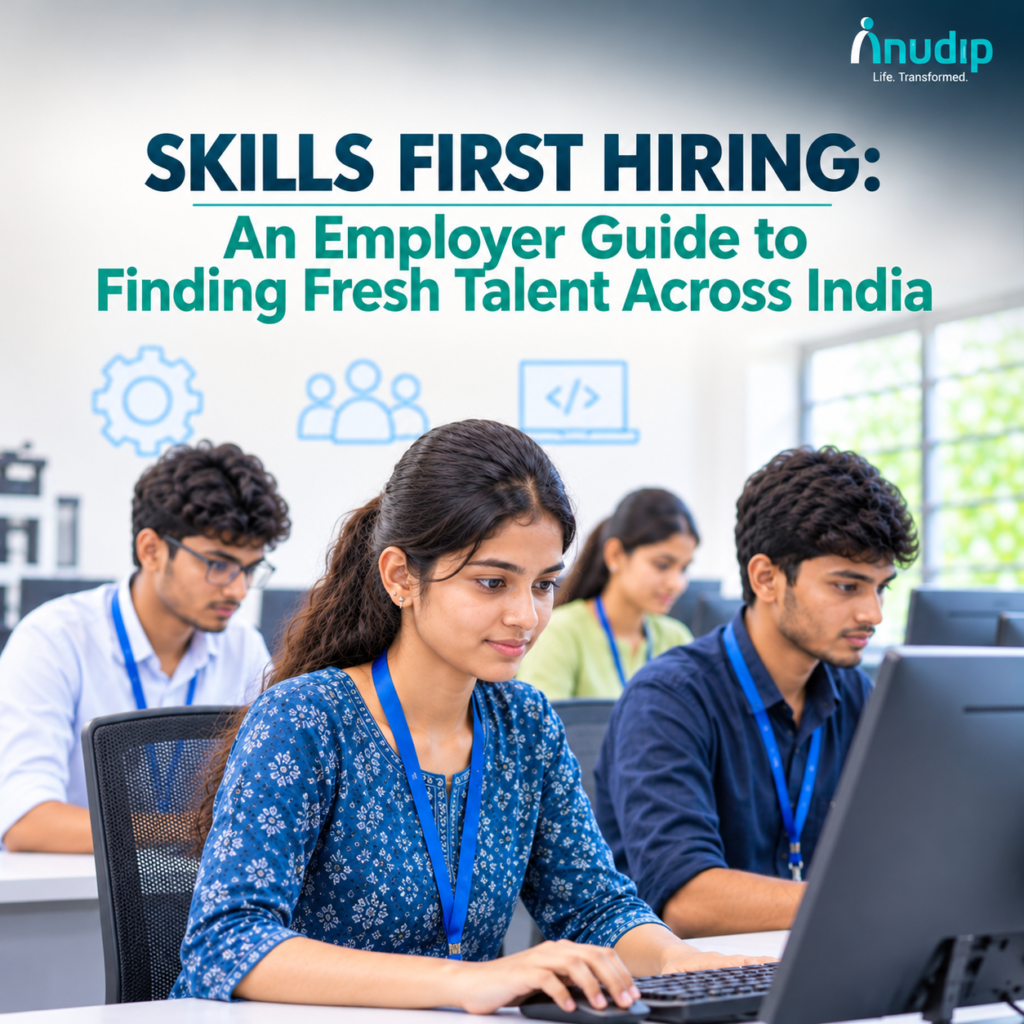
Anudip Foundation has trained over 7.3 lakh young people across 22 Indian states, more than half of them women, for jobs in IT and ITeS, BFSI, retail, customer service and the green economy. Recruiters can save a lot of screening time with such pre-assessed candidate pools.
How Anudip Builds Talent Ready for Skills First Hiring
Anudip’s programs are designed to prepare young Indians for the jobs available today and the roles still taking shape tomorrow.
- Employer-informed pedagogy: Shaped with industry input, our approach replaces rote learning with inquiry and hands-on practice, as trainers guide learners to find answers themselves.
- AI readiness in every course: A progressive curriculum developed with industry partners takes learners from AI literacy to confident use and, ultimately, building with AI. It runs across technical and non-technical courses, supported by AI Centres of Excellence in major cities and two in-house AI coaches that extend practice at home.
- Industry-aligned curricula: Courses spanning IT, digital, communication and green economy skills are revised with employer input as roles evolve.
- Workplace readiness: Mock interviews, industry visits and conduct sessions prepare learners before their first day.
Read more: How AI Is Reshaping the Future of Work for Underserved Communities in India
Final Thoughts: Hiring for Capacity, Not Credentials
Back at the hiring manager’s desk, the next round looks different. The job description lists tasks instead of degrees. Candidates complete a short work sample, receive feedback and revise it. The young graduate who never cleared a shortlist now has a chance to show her thinking, and she does. Six months on, she is the one helping newer colleagues learn the tools.
A CV captures a moment in time, while learning agility compounds with every role. Skills first hiring gives employers a practical way to build teams that adapt as quickly as their industries do. It also lets them reach talent the old filters would have missed.
FAQs
- What is skills first hiring and how does it differ from degree-based hiring?
It assesses candidates on demonstrated skills through practical tasks as well as work samples. Degree-based hiring uses qualifications as a stand-in for capability, while skills first hiring focuses on capability directly. - Is skills first hiring suitable for entry-level roles in India?
Yes. Entry-level candidates have little or no experience to show. Practical assessments are often the most trusted way to compare them. This is particularly applicable for applicants from tier 2 and tier 3 towns. - How can employers assess learning agility in candidates with no work experience?
The best way is to give a short, role-relevant task, share feedback and ask for a revision. Also asking what the candidate has recently taught themselves can give a better view of what they can take up and accomplish. How they’re applying feedback reveals way more than any CV. - Do employers need to drop degree requirements entirely?
No. Keep them where a role legally or technically requires a qualification. Elsewhere, you must treat degrees as one signal among many rather than just a screening filter. - What should a skills-based job description include?
It should list the core tasks of the role, the skills those tasks require and how each will be analysed. - Where can employers in India find trained, job-ready fresh talent?
Beyond campus hiring, skilling organisations offer pre-trained and pre-assessed candidate pools. For example, Anudip Foundation, runs more than 100 job drives a year and reports a 70% placement rate.